
Running an ecommerce store is not only about having great products.
Your products also need to be found.
A customer may be searching for exactly what you sell, but if your product or category page is poorly optimized, Google may not understand its purpose. The same page may also struggle to appear in Google Shopping, image results, AI generated answers, or other search experiences.
This is where on-page SEO for ecommerce becomes important.
On-page SEO is the process of improving the content, structure, links, images, metadata, and other elements on your website so search engines and customers can better understand your pages.
For ecommerce websites, this work needs to be done differently from a normal blog or service website.
A store may have hundreds, thousands, or even millions of URLs. It may also have product variants, filters, sorting pages, duplicate descriptions, out of stock products, reviews, and dynamically generated URLs.
That creates a much bigger SEO challenge.
In this guide, we will explain how to approach ecommerce on-page SEO from the ground up. We will cover product pages, category pages, keyword targeting, title tags, descriptions, headings, URLs, images, internal links, structured data, reviews, user experience, AI search, LLM citations, entity SEO, E-E-A-T, and more.
What Is On-Page SEO for Ecommerce?
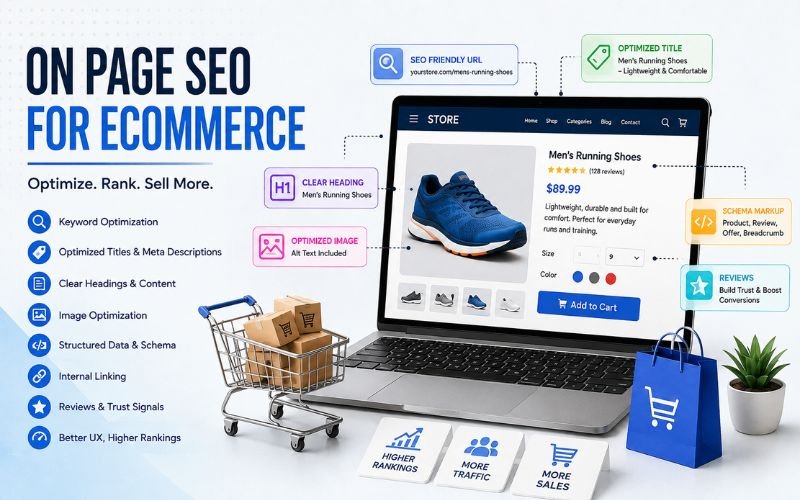
On-page SEO for ecommerce is the process of optimizing individual product, category, collection, brand, and supporting content pages so search engines can understand their relevance and shoppers can make informed buying decisions.
It includes elements such as:
- Keyword targeting
- Search intent
- Title tags
- Meta descriptions
- H1 and heading structure
- Product descriptions
- Category content
- URLs
- Image optimization
- Internal linking
- Product schema
- Breadcrumbs
- Reviews
- FAQs
- Shipping and return information
- Content quality
- User experience
- Entity information
- AI search visibility
Google recommends making ecommerce pages easy to discover through navigation and internal links. It also recommends using structured data to help Google understand the purpose and information on ecommerce pages.
The goal is not simply to insert keywords into a page.
The goal is to create a page that clearly answers:
What is this product or category?
Who is it for?
Why should someone buy it?
What makes it different?
How does it compare with alternatives?
Can Google and other search systems clearly understand it?
That is the foundation of modern ecommerce SEO.
Why On-Page SEO Matters for Ecommerce Websites
Ecommerce SEO has one major advantage over many other types of SEO.
The searcher often has a strong buying intent.
Someone searching for:
“best running shoes for flat feet”
is researching.
Someone searching for:
“buy men’s waterproof hiking boots”
is much closer to making a purchase.
Your website needs the right page for each type of search.
A product page should not try to rank for every possible keyword.
A category page should not compete with individual product pages.
A blog post should not compete with a commercial landing page.
Each page needs a clear purpose.
Google also looks at the relationships between pages through internal links. Strong ecommerce architecture helps Google understand which pages are important and how products relate to categories and other content.
This means on-page SEO is not just about individual pages.
It is about how the entire store works together.
1. Start With Ecommerce Keyword Research
Before optimizing your pages, determine what your customers are actually searching for.
Do not begin by writing product descriptions.
Begin with keyword research.
Your research should consider:
- Search volume
- Search intent
- Competition
- Product relevance
- Commercial value
- Long-tail searches
- Brand searches
- Product searches
- Category searches
- Comparison searches
- Problem-based searches
For example, imagine you sell running shoes.
Your keyword groups might include:
Product keywords
- Nike running shoes
- men’s trail running shoes
- women’s running shoes
- carbon plate running shoes
Category keywords
- running shoes
- trail running shoes
- road running shoes
- running shoes for beginners
Commercial investigation keywords
- best running shoes for flat feet
- best trail running shoes
- running shoes for long distance
Informational keywords
- how should running shoes fit
- how often should you replace running shoes
- how to clean running shoes
Each keyword group may deserve a different page.
That is why keyword mapping is so important.
2. Match Keywords With Search Intent
Keyword research alone is not enough.
You need to understand why the person is searching.
A useful ecommerce intent model includes four main categories.
| Search Intent | Example | Best Page |
| Informational | how to clean leather shoes | Blog/guide |
| Commercial | best leather shoes for work | Guide/category |
| Transactional | buy men’s leather shoes | Product/category |
| Navigational | Nike official store | Brand/product page |
One of the most common ecommerce SEO mistakes is targeting the right keyword on the wrong page.
For example, creating a blog post for “buy men’s leather shoes” is usually not the best approach.
The user wants products.
They should land on a category or product page.
Search intent should determine the page type.
3. Create a Clear Keyword Map
Once you have your keywords, map them to individual URLs.
A simple keyword map can look like this:
| Page | Primary Keyword | Secondary Keywords |
| Homepage | Online shoe store | buy shoes online |
| Category | men’s running shoes | running shoes for men |
| Subcategory | men’s trail running shoes | trail shoes for men |
| Product | Nike Pegasus 41 | Nike Pegasus running shoes |
| Blog | how to choose running shoes | running shoe buying guide |
This prevents keyword cannibalization.
Keyword cannibalization happens when multiple pages compete for the same search intent.
For example, if five category pages are all optimized for “running shoes,” Google may struggle to understand which page should rank.
A strong keyword map gives every important page a clear job.
4. Optimize Ecommerce Title Tags
The title tag remains one of the most important on-page elements.
Google explains that title links help users understand what a search result is about. Google recommends descriptive, concise titles and warns against keyword stuffing and repeated boilerplate titles.
A good ecommerce title should be:
- Clear
- Specific
- Relevant
- Unique
- Written for humans
- Aligned with search intent
Weak example
Shoes | Shoes Online | Best Shoes | Buy Shoes
This looks unnatural.
Better example
Men’s Trail Running Shoes | Waterproof & Lightweight
For a product:
Nike Pegasus 41 Men’s Running Shoes | Niche Store
Do not force the exact keyword several times.
One strong, descriptive title is usually better than a keyword stuffed title.
5. Write Better Meta Descriptions
Meta descriptions are not simply keyword fields.
They are an opportunity to convince someone to click.
A strong ecommerce meta description can mention:
- Product or category
- Key benefit
- Important feature
- Buying advantage
- Brand
- Call to action
For example:
Shop men’s trail running shoes built for grip, comfort and long distance performance. Explore top styles and find the right pair for your next adventure.
The description should match the page.
Do not promise something that the page does not provide.
6. Create One Clear H1
Every important ecommerce page should have a clear main heading.
For a category:
Men’s Trail Running Shoes
For a product:
Nike Pegasus 41 Men’s Running Shoes
The H1 should tell both the customer and search engines what the page is about.
Do not turn your H1 into a list of keywords.
Avoid:
Running Shoes Men’s Running Shoes Best Running Shoes Cheap Running Shoes
That is poor UX and unnecessary keyword stuffing.
7. Build a Logical Heading Structure
Use H2 and H3 headings to organize longer ecommerce pages.
For example:
Men’s Trail Running Shoes
Introduction
How to Choose Trail Running Shoes
Cushioning
Grip
Waterproofing
Best Uses for Trail Running Shoes
Frequently Asked Questions
The heading structure should follow the content.
Do not create headings only because you want to insert keywords.
Good headings make pages easier to scan.
They also help search engines understand the relationships between different sections.
8. Optimize Product Descriptions
Product descriptions are one of the biggest opportunities for ecommerce websites.
Many stores copy descriptions directly from manufacturers.
That creates a problem.
If ten stores use the same manufacturer description, none of those pages gives Google much unique information.
Your product descriptions should explain the product in your own words.
Include:
- What the product is
- Who it is for
- Main benefits
- Important features
- Materials
- Dimensions
- Size information
- Use cases
- Compatibility
- Care instructions
- Warranty information
- Shipping information where relevant
Do not write 500 words just to reach a word count.
Write enough information to help the customer make a decision.
Google’s guidance consistently emphasizes useful, relevant content rather than content created simply to manipulate rankings.
9. Optimize Category Pages
Category pages are often some of the most valuable SEO pages on an ecommerce website.
They can target broader commercial keywords while linking users to relevant products.
A strong category page can include:
- Clear H1
- Short introduction
- Product listings
- Helpful category description
- Buying guidance
- Relevant subcategories
- FAQs
- Internal links
- Breadcrumbs
- Supporting content
For example:
Women’s Hiking Boots
Start with a short introduction.
Then show the products.
Below the product grid, provide useful information such as:
- How to choose hiking boots
- Waterproof vs non-waterproof boots
- Hiking boot materials
- Choosing the right fit
- How much ankle support you need
This gives the category page more value than a simple product grid.
10. Avoid Thin Category Content
A common ecommerce mistake is creating category pages that contain nothing except a product grid.
That can make it difficult to differentiate one category from another.
The solution is not to add meaningless paragraphs.
Instead, answer real customer questions.
For example:
What type of hiking boots do I need?
Are waterproof hiking boots worth it?
What is the difference between hiking boots and hiking shoes?
How should hiking boots fit?
Useful content can support both rankings and conversions.
11. Improve Ecommerce URL Structure
Your URLs should be simple and descriptive.
For example:
/mens-running-shoes/
/mens-running-shoes/nike-pegasus-41/
is much easier to understand than:
/product?id=84938&cat=392&ref=abc
Google’s ecommerce documentation recommends stable, meaningful URLs and warns about URL parameters, duplicate URLs, and temporary parameters. Google also recommends consistent URLs across internal links, canonical tags, and sitemaps.
Avoid changing URLs unless there is a good reason.
If you must change a URL, use the appropriate redirect strategy.
12. Optimize Product Images
Images are essential for ecommerce.
They influence both search visibility and conversion.
Your product images should be:
- High quality
- Properly sized
- Compressed
- Responsive
- Descriptive
- Relevant to the product
Use descriptive file names.
Instead of:
IMG_2388.jpg
Use:
black-leather-mens-wallet.jpg
Also write useful alt text.
For example:
Black leather men’s wallet with multiple card slots
Do not stuff keywords into alt text.
Alt text should describe the image.
Google notes that ecommerce products can appear across surfaces such as Google Search, Google Images, and Google Lens.
That makes image optimization an important part of ecommerce SEO.
13. Use Product Structured Data
Structured data gives search engines machine-readable information about your page.
For ecommerce, relevant structured data can include:
- Product
- Offer
- AggregateRating
- Review
- BreadcrumbList
- Organization
- LocalBusiness where appropriate
Product structured data can help Google understand details such as:
- Product name
- Price
- Availability
- Ratings
- Reviews
- Shipping information
- Return information
Google says product structured data can make pages eligible for richer search experiences, including product information in Google Search, Images, and Lens.
But there is an important distinction.
Schema does not guarantee rankings.
It helps search engines understand your information and can make your pages eligible for certain search features.
14. Keep Product Data Consistent
Your product information should match across your website and shopping feeds.
Pay particular attention to:
- Product name
- Price
- Availability
- SKU
- Brand
- Product identifiers
- Images
- Shipping information
- Returns
- Variants
If your website says one price and your product feed says another, you can create trust and eligibility problems.
Ecommerce SEO is no longer isolated from product feeds.
Your website, structured data, Merchant Center data, and product information should work together.
15. Handle Product Variants Correctly
Many ecommerce websites sell products in multiple:
- Sizes
- Colors
- Materials
- Styles
- Pack sizes
- Configurations
These variants can create many URLs.
For example:
/shirt/
/shirt?color=black
/shirt?color=blue
/shirt?size=large
You need a clear strategy for deciding which URLs should be indexed.
Google recommends using consistent URL structures and canonicalization when handling product variants.
Do not allow thousands of nearly identical URLs to compete with the main product page.
16. Control Faceted Navigation
Filters are useful for customers.
They can also create major SEO problems.
Imagine an ecommerce store with filters for:
- Color
- Size
- Brand
- Price
- Material
- Rating
- Style
Combining those filters can create thousands or even millions of URLs.
Not every filtered URL deserves to appear in Google.
You need to determine which combinations have genuine search demand.
Useful landing pages can sometimes be indexed.
Low-value combinations usually should not become indexable SEO pages.
This is one area where ecommerce on-page SEO overlaps heavily with technical SEO.
17. Strengthen Internal Linking
Internal links help users discover related products and help search engines understand site structure.
Google specifically recommends making important ecommerce pages reachable through links and explains that the number and relationship of internal links can help Google understand page importance.
Good ecommerce internal links include:
- Category → Product
- Product → Related Product
- Product → Category
- Blog → Product
- Blog → Category
- Category → Subcategory
- Buying Guide → Products
For example, a blog about:
How to Choose a Hiking Backpack
could link to:
Hiking Backpacks
and specific products.
Use descriptive anchor text.
Instead of:
Click here
use:
Shop lightweight hiking backpacks
This gives users more context.
18. Optimize Breadcrumbs
Breadcrumbs help customers understand where they are.
For example:
Home → Hiking Gear → Backpacks → Hiking Backpacks
They also help search engines understand the relationship between pages.
Google identifies BreadcrumbList as a relevant structured data type for ecommerce websites.
Breadcrumbs are particularly valuable for large stores with multiple category levels.
19. Add Helpful Product FAQs
FAQs can improve the usefulness of a product page.
Consider questions customers actually ask.
For example:
Is this product waterproof?
What size should I choose?
Does it come with a warranty?
How long does shipping take?
Can I return this product?
Is this compatible with older models?
The answers should be visible on the page.
Do not create FAQs simply to insert keywords.
Answer real questions.
20. Use Real Customer Reviews
Customer reviews can make product pages much stronger.
They provide information that your internal marketing copy may not cover.
Customers may mention:
- Fit
- Quality
- Durability
- Packaging
- Comfort
- Ease of use
- Performance
- Real-world problems
Reviews can also help future shoppers make decisions.
The key is authenticity.
Do not create fake reviews.
Do not manipulate review ratings.
Use genuine customer feedback and make it easy for shoppers to understand the context.
21. Optimize for E-E-A-T
E-E-A-T stands for:
Experience
Expertise
Authoritativeness
Trustworthiness
For ecommerce websites, trust matters enormously.
A customer needs confidence before spending money.
Make important information easy to find.
Include:
- Contact information
- Shipping policy
- Return policy
- Warranty information
- Payment information
- About page
- Customer support
- Business information
- Product specifications
- Genuine reviews
For products where expertise matters, demonstrate real knowledge.
Do not simply say that your product is “the best.”
Explain why.
Provide evidence.
22. Optimize for Entity SEO
Modern search engines do not only match keywords.
They also try to understand entities and relationships.
An ecommerce product can be connected to:
- Brand
- Manufacturer
- Product category
- Material
- Model
- SKU
- Product type
- Use case
- Features
- Compatible products
- Related products
For example, instead of repeatedly writing:
Nike Pegasus 41
your content can naturally explain:
Nike Pegasus 41 is a neutral running shoe designed for everyday road running.
This creates contextual relationships.
The goal is to help search engines understand what the product actually is.
23. Semantic SEO for Ecommerce
Semantic SEO means covering the concepts that naturally belong to a topic.
Suppose your target keyword is:
standing desk
A useful page may naturally discuss:
- Adjustable height
- Electric standing desk
- Desk height
- Ergonomic setup
- Desktop size
- Weight capacity
- Stability
- Cable management
- Memory presets
- Sitting and standing
- Office setup
You do not need to force these phrases into every paragraph.
Cover them because they help customers understand the product.
That creates stronger topical relevance.
24. Optimize Ecommerce Pages for AI Search and LLMs
Search is changing.
Customers increasingly use AI systems to research products, compare brands, and find recommendations.
Google has expanded AI features in Search, including AI Overviews and AI Mode.
This creates a new question for ecommerce brands:
How can my products and brand become visible in AI generated answers?
The answer is not to abandon traditional SEO.
It is to make your existing SEO stronger.
Google’s current guidance says there are no special technical requirements or special markup required to appear in AI Overviews or AI Mode. Google also says its existing SEO fundamentals remain important for generative AI search.
25. Make Product Information Easy for LLMs to Understand
AI systems need clear information.
Avoid hiding essential product information behind unnecessary interactions.
Make important facts easy to find.
For example:
Product: Men’s Waterproof Hiking Boots
Material: Full-grain leather
Waterproof: Yes
Sole: Vibram rubber
Best for: Hiking, trekking and wet conditions
Available sizes: 7 to 13
Warranty: 12 months
This structure helps humans.
It also makes important product facts easier for machines to interpret.
26. How to Increase Your Chances of Being Cited by AI
There is no guaranteed method for getting an AI system to cite your ecommerce website.
However, strong fundamentals can improve your chances of being understood and referenced.
Focus on:
Clear answers
Answer important questions directly.
Original information
Do not simply repeat supplier copy.
Specific facts
Provide useful product specifications, comparisons, measurements, and details.
Strong topical coverage
Create supporting content around your products and categories.
Internal relationships
Connect products, categories, guides, and related topics.
Trust signals
Make your business, authorship, policies, and product information clear.
Third-party authority
Earn genuine mentions, reviews, links, and citations from relevant websites.
Google’s guidance emphasizes creating unique, useful, non-commodity content for generative AI search rather than trying to manipulate AI systems with special formatting or artificial tactics.
27. Do You Need an llms.txt File?
This is one of the most misunderstood topics in AI SEO.
The short answer is:
You do not need an llms.txt file to rank in Google or appear in Google AI Overviews.
Google’s current documentation says Google Search does not use llms.txt for ranking or visibility.
Google also says creating one will neither help nor hurt your Google Search visibility.
That means an ecommerce business should not prioritize llms.txt over:
- Technical SEO
- Product optimization
- Category optimization
- Internal linking
- Structured data
- Content quality
- Merchant Center
- Reviews
- Authority building
If another AI system eventually uses llms.txt, maintaining one may have a separate purpose.
But it should not replace real SEO work.
28. Create Content Around the Buying Journey
Not every customer is ready to buy immediately.
Your content should support different stages.
Awareness
What are the best hiking shoes for beginners?
Research
Leather vs synthetic hiking boots
Comparison
Salomon vs Merrell hiking shoes
Purchase
Buy Salomon hiking shoes online
Post-purchase
How to clean Salomon hiking shoes
This creates a complete content ecosystem.
Your blog attracts shoppers.
Your category pages target commercial searches.
Your product pages convert purchase-ready visitors.
Your internal links connect everything.
29. Improve Category-to-Product Relevance
Your category page should help Google and users understand what the products have in common.
For example:
Women’s Running Shoes
should link to products such as:
- Neutral running shoes
- Stability running shoes
- Lightweight running shoes
- Long-distance running shoes
You can also create useful subcategories when there is genuine demand.
The structure should reflect how customers actually shop.
30. Optimize Out-of-Stock Products Carefully
Do not automatically delete every product that becomes unavailable.
An old product page may have:
- Backlinks
- Rankings
- Organic traffic
- Reviews
- Internal links
- Brand value
Instead, evaluate the page.
If the product will return, keeping the page available may make sense.
If it is permanently discontinued, consider whether:
- A closely related replacement exists
- A suitable redirect is available
- The page still provides useful information
- The URL has valuable authority
The correct decision depends on the situation.
31. Improve Ecommerce Page Speed
Page speed affects the shopping experience.
Large product images, third-party scripts, tracking tools, apps, plugins, and unnecessary JavaScript can slow down ecommerce stores.
Pay attention to:
- Largest Contentful Paint
- Interaction to Next Paint
- Cumulative Layout Shift
- Image size
- JavaScript
- CSS
- App scripts
- Fonts
- Server response time
Do not optimize speed only for SEO.
Optimize it because customers expect pages to load quickly.
32. Make Ecommerce Pages Mobile Friendly
Your mobile experience should not be an afterthought.
Check:
- Product images
- Product titles
- Product descriptions
- Navigation
- Filters
- Add to cart buttons
- Reviews
- Variant selectors
- Checkout
- Popups
- Sticky elements
A page can rank well and still lose sales if the mobile experience is difficult.
SEO and conversion optimization should work together.
33. Optimize for Conversion Without Destroying SEO
SEO brings visitors.
Conversion optimization helps turn them into customers.
Do not hide important information just to create a cleaner design.
Your product page should make it easy to understand:
- What the product is
- How much it costs
- Whether it is available
- What it does
- Why it is useful
- How quickly it ships
- How it can be returned
- Why the customer should trust you
Strong SEO pages should also be strong sales pages.
34. Common Ecommerce On-Page SEO Mistakes
Here are some of the problems we regularly see on ecommerce websites.
Copying manufacturer descriptions
This creates generic product pages.
Using the same title for multiple products
Each important page should have a meaningful title.
Keyword stuffing
Writing unnatural copy does not create better SEO.
Ignoring category pages
Category pages can be powerful commercial landing pages.
Indexing every filter URL
This can create massive URL duplication.
Weak internal linking
Important products become difficult for users and crawlers to discover.
Poor image optimization
Large images can slow down pages.
Missing product structured data
You lose opportunities to communicate product information clearly to search engines.
Ignoring product variants
Variants can create duplicate and indexing problems.
Writing content only for Google
Customers should always come first.
Chasing AI hacks
There is no magic AI schema or file that guarantees AI citations.
Strong SEO fundamentals remain the foundation.
35. Ecommerce On-Page SEO Checklist
Use this checklist when optimizing a product or category page.
Keyword
- Primary keyword selected
- Search intent confirmed
- Secondary topics identified
- Keyword mapped to the correct URL
Title and Metadata
- Unique title tag
- Clear primary topic
- Natural wording
- Compelling meta description
Content
- Unique product description
- Useful category content
- Benefits explained
- Features explained
- Relevant questions answered
- No unnecessary keyword stuffing
Headings
- One clear H1
- Logical H2s
- Useful H3s where necessary
Images
- Descriptive file names
- Useful alt text
- Compressed images
- Responsive images
- High quality product photography
Internal Links
- Category links to products
- Products link to relevant categories
- Related products linked
- Supporting blog content linked
Technical Elements
- Clean URL
- Canonical URL
- Indexing reviewed
- Mobile experience checked
- Page speed reviewed
- Structured data validated
Ecommerce Trust
- Reviews
- Shipping information
- Return policy
- Warranty information
- Contact information
- Business information
AI Search
- Important information is visible
- Product facts are clearly stated
- Content answers real questions
- Supporting content exists
- Internal entities are connected
- Third-party authority is being built
- No dependence on llms.txt
36. How Niche SEO Agency Approaches Ecommerce On-Page SEO
We do not treat ecommerce on-page SEO as simply changing title tags and adding keywords.
A successful campaign needs to connect content, technical SEO, product data, search intent, user experience, and revenue.
Our ecommerce SEO approach can include:
Ecommerce SEO Audit
We identify problems affecting crawlability, indexation, content quality, internal linking, product visibility, and organic performance.
Keyword Research
We identify commercial, transactional, informational, product, category, long-tail, and semantic search opportunities.
Product Page Optimization
We optimize product titles, descriptions, headings, images, internal links, structured data, and supporting content.
Category Page Optimization
We build stronger commercial landing pages that target broader search demand.
Internal Linking
We connect products, categories, guides, and supporting content to create a logical website structure.
Technical SEO
We address duplicate URLs, canonicalization, faceted navigation, indexing, site speed, Core Web Vitals, and crawlability.
Structured Data
We implement and validate relevant ecommerce schema.
Google Merchant Center
We help align website product information with shopping feed data and Google Merchant Center requirements.
AI Search Optimization
We improve entity understanding, topical authority, structured information, product knowledge, and content quality for modern AI search experiences.
Conversion Optimization
We look beyond rankings.
The real question is:
Is organic search generating qualified visitors and revenue?
Final Thoughts
On-page SEO for ecommerce is much more than adding keywords to product descriptions.
It is about making every important page useful, understandable, discoverable, and commercially relevant.
Your product pages should help customers make decisions.
Your category pages should help customers discover products.
Your blog content should answer questions and support the buying journey.
Your internal links should connect the entire website.
Your structured data should clearly communicate product information.
Your technical setup should make important pages easy to crawl and index.
And your content should be strong enough to be understood across traditional search and newer AI powered search experiences.
Google’s ecommerce guidance reinforces the importance of crawlable navigation, structured data, meaningful site architecture, and useful content.
The future of ecommerce search is broader than traditional rankings.
Customers may discover your products through Google Search, Google Images, Google Shopping, Google Lens, AI Overviews, AI Mode, ChatGPT, Gemini, Perplexity, and other emerging experiences.
But the foundation remains the same:
Create excellent pages for real customers, make your information clear, build a technically sound website, and give search engines reliable signals about what your products and business represent.
That is the type of ecommerce SEO strategy that can continue to work as search evolves.
Ready to Improve Your Ecommerce SEO?
If your ecommerce website is attracting traffic but not generating enough sales, the problem may not be your products.
Your pages may simply need a better SEO structure.
Niche SEO Agency provides ecommerce SEO services for Shopify, WooCommerce, Magento, BigCommerce, and custom ecommerce websites.
We can help you identify:
- Which product pages need optimization
- Which category pages have the greatest opportunity
- Where your website is losing organic visibility
- Which keywords can generate commercial traffic
- How to improve internal linking
- How to strengthen product and category content
- Where technical SEO is limiting growth
- How to improve your visibility across modern search experiences
Ready to turn your ecommerce website into a stronger organic sales channel? Contact Niche SEO Agency for a customized ecommerce SEO strategy.