Launching a Shopify store is relatively easy. Getting the store in front of the right customers is much harder.
You can have great products, attractive branding, competitive pricing, and a well-designed storefront, yet still struggle to generate organic traffic. The problem is often not the Shopify platform itself. It is how the store is structured, how products and collections are optimized, how Google understands the site, and whether your content answers the questions customers are actually searching for.
That is where Shopify SEO services can make a meaningful difference.
We help Shopify businesses improve their visibility across Google Search, Google Shopping, Google Images, and newer AI-powered search experiences. Our approach combines technical SEO, product and collection optimization, content strategy, structured data, internal linking, authority building, and conversion-focused improvements.
The goal is simple: bring more qualified shoppers to your store and turn organic search into a reliable source of revenue.
What Is Shopify SEO?
Shopify SEO is the process of optimizing a Shopify store so that search engines can crawl, understand, index, and rank its pages for relevant searches.
It includes much more than adding keywords to product descriptions.
A complete Shopify SEO strategy can involve:
- Technical SEO
- Keyword research
- Product page optimization
- Collection page optimization
- Site architecture
- Internal linking
- Metadata optimization
- Image SEO
- Structured data and schema markup
- Duplicate content management
- URL and canonical optimization
- Shopify blog SEO
- Content marketing
- Link building
- Google Merchant Center optimization
- Core Web Vitals and performance
- Conversion rate optimization
- AI search and LLM visibility
- Search Console and analytics monitoring
The important point is that SEO should support the shopping experience rather than work against it. Customers should be able to find what they need quickly, understand the product, trust the brand, and complete their purchase without unnecessary friction.
Why Does Your Shopify Store Need SEO?
Shopify gives you a strong ecommerce foundation, but the platform does not automatically make every product page rank.
Think about a store selling 500 products. If each product page has a generic description copied from the manufacturer, weak internal links, poorly optimized images, and little supporting content, Google has very little reason to consider those pages particularly useful.
Now imagine the same store with:
- Unique product descriptions based on search intent
- Well-structured collections
- Clear product relationships
- Strong internal links
- Useful buying guides
- Helpful comparison content
- Optimized images
- Accurate product structured data
- A clean technical setup
- Relevant backlinks
- Strong brand signals
That gives search engines much more context.
It also gives customers more reasons to trust the store.
Google provides multiple opportunities for ecommerce businesses to appear across Search, Images, Lens, Shopping-related experiences, and other surfaces. Product structured data and Merchant Center product information can help Google understand and present ecommerce information across these experiences.
Our Shopify SEO Services
We do not treat every Shopify store the same. A 30-product fashion store has different SEO requirements from a 10,000-product electronics store.
Our Shopify SEO services are built around your catalog, competition, customers, and revenue goals.
1. Shopify SEO Audit
We start by understanding what is currently holding your store back.
Our audit examines the technical and search-related elements that influence organic performance, including:
- Indexing and crawlability
- XML sitemap
- Robots.txt
- Canonical tags
- Redirects
- Broken links
- Duplicate URLs
- Product and collection architecture
- Metadata
- Heading structure
- Internal links
- Image optimization
- Structured data
- Mobile experience
- Core Web Vitals
- Search Console data
- Organic keyword performance
- Competitor visibility
- Content gaps
- Backlink profile
The objective is not to produce a giant list of problems that nobody has time to fix. We prioritize issues based on their likely impact on visibility, traffic, and revenue.
2. Shopify Keyword Research
Good SEO starts with understanding what potential customers search for.
We research keywords around different stages of the buying journey.
For example, someone selling running shoes might target:
Informational
- how to choose running shoes
- best running shoes for beginners
- how should running shoes fit
Commercial
- best running shoes for flat feet
- lightweight running shoes
- running shoes for long distance
Transactional
- buy running shoes online
- men’s running shoes
- women’s running shoes
The strategy is not to force every keyword into a product page.
Instead, we map keywords to the page that best satisfies the search intent.
Product keywords belong on product pages. Broader category terms often belong on collection pages. Research questions may belong in blog posts, buying guides, or comparison content.
This creates a more logical relationship between search intent and your Shopify site architecture.
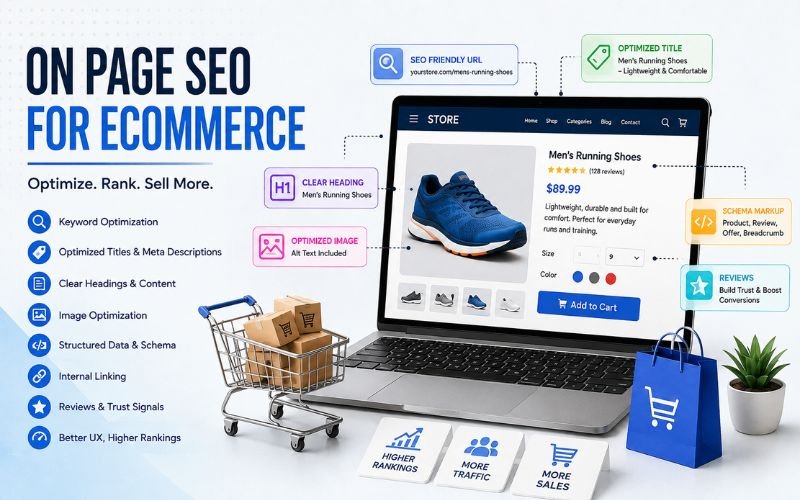
3. Product Page SEO
Your product pages are where SEO and revenue meet.
A product page needs to satisfy both search engines and real shoppers.
We optimize elements such as:
- Product titles
- Meta titles
- Meta descriptions
- Product descriptions
- H1 headings
- Product specifications
- Images
- Image alt text
- FAQs
- Reviews
- Internal links
- Related products
- Breadcrumbs
- Product structured data
- Shipping and return information
We also look for opportunities to make product descriptions genuinely useful.
Instead of writing:
“Premium quality cotton shirt available in multiple colors.”
A better product page could explain who the product is for, how it fits, what makes the material different, how it should be cared for, and what customers should know before purchasing.
That information can improve both search relevance and conversion potential.
Product Schema and Shopify SEO
Product structured data is particularly important for ecommerce.
Google explains that product markup can help eligible pages appear with additional information such as price, availability, reviews, and other product details. Merchant listing markup is designed specifically for pages where customers can purchase products.
However, schema should never be treated as a magic ranking button.
The structured data must accurately represent the visible page content and follow Google’s guidelines. Google also makes clear that valid structured data does not guarantee that a rich result will appear.
For stores with product variants, we also consider appropriate ProductGroup and variant structured data where applicable. Google provides specific guidance for grouping products by attributes such as size, color, material, or pattern.
4. Shopify Collection Page SEO
Many Shopify stores focus heavily on products and overlook their collection pages.
That can be a mistake.
Collection pages can target broader, high-value commercial searches and act as important entry points into your website.
For example, a store selling skincare products might have collections for:
- Face moisturizers
- Vitamin C serums
- Sensitive skin products
- Anti-aging skincare
- Natural skincare
Each collection should have a clear purpose and target a meaningful search theme.
We optimize:
- Collection titles
- Collection URLs
- H1 headings
- Collection descriptions
- Product ordering
- Internal links
- Breadcrumbs
- Supporting content
- Metadata
- Structured data where appropriate
We also avoid adding unnecessary blocks of SEO text simply to make a page longer.
The content should help shoppers make decisions.
5. Shopify Technical SEO
Technical SEO becomes increasingly important as your catalog grows.
A store with hundreds or thousands of products can create technical problems that are difficult to spot from the front end.
Our Shopify technical SEO work can include:
Crawlability
We examine how search engines discover important pages and whether unnecessary URLs are consuming crawl resources.
Indexation
Not every URL generated by a Shopify store deserves to be indexed.
We identify pages that should be indexed, pages that require consolidation, and pages that may need different handling.
Canonicalization
Duplicate or near-duplicate URLs can create confusion about which version should be treated as the primary page.
We review canonical signals and investigate situations where multiple URLs represent substantially similar content.
Redirects
When products, collections, or pages are removed or renamed, old URLs should not simply disappear without consideration.
Relevant redirects can preserve user access and help maintain valuable signals.
Sitemap
We check that important URLs are discoverable and that the site’s sitemap setup supports efficient crawling.
Mobile SEO
Your Shopify store needs to work well on mobile devices. Navigation, product images, menus, buttons, filters, and checkout-related interactions should be easy to use on smaller screens.
Core Web Vitals
We investigate performance issues that affect real users, particularly on mobile.
Common problems include:
- Oversized images
- Heavy apps
- Excessive scripts
- Poorly optimized theme code
- Unnecessary third-party resources
A faster store can provide a better user experience while also supporting stronger technical health.
6. Shopify App and Theme SEO Review
One advantage of Shopify is the large ecosystem of apps and themes.
The downside is that installing too many apps can create unnecessary code, scripts, duplicate functionality, or performance problems.
We review the SEO impact of:
- SEO apps
- Review apps
- Popups
- Tracking scripts
- Page builders
- Search and filter apps
- Marketing integrations
- Theme code
- Third-party JavaScript
The goal is not to remove useful tools just because they exist.
We identify what is actually necessary and whether it is creating an SEO or performance issue.
7. Internal Linking for Shopify Stores
Internal links are often overlooked on ecommerce websites.
A strong internal linking structure helps users discover related products and helps search engines understand relationships between pages.
For example:
Blog article → Collection → Product
A guide about choosing hiking boots could link to a hiking footwear collection, which then links to specific products.
Similarly:
Product → Related Product → Collection → Buying Guide
This creates useful paths through the website rather than leaving products isolated.
We develop internal linking strategies around:
- Products
- Collections
- Categories
- Blog posts
- Buying guides
- Comparison pages
- Brand pages
- Important commercial pages
8. Shopify Content Marketing
Product pages alone are often not enough to compete in difficult markets.
Your customers have questions before they buy.
Those questions create content opportunities.
Depending on the business, we may recommend:
- Buying guides
- Product comparisons
- How-to articles
- Product education
- FAQs
- Brand comparisons
- Size guides
- Care guides
- Troubleshooting content
- Industry resources
- Seasonal shopping guides
For example, a mattress store could create content around mattress firmness, sleeping positions, mattress sizes, cooling materials, and product comparisons.
This allows the website to attract shoppers earlier in the buying process and then guide them toward relevant products.
9. Shopify SEO for Google Shopping and Merchant Center
Traditional organic rankings are only one part of ecommerce search visibility.
Google provides several surfaces where product information can appear.
We help Shopify stores improve the quality and consistency of product information used across their ecommerce ecosystem.
This can include:
- Product titles
- Product descriptions
- Product identifiers
- Product categories
- Product images
- Availability
- Pricing
- Shipping information
- Return information
- Merchant Center feed quality
Google recommends combining product structured data on your website with a Merchant Center feed to provide Google with reliable ecommerce product information.
This is particularly important for stores that want to expand beyond traditional blue-link rankings.
10. Shopify SEO for AI Search and LLMs
Search behavior is changing.
People increasingly ask systems such as Google AI Overviews, Google AI Mode, ChatGPT, Gemini, and Perplexity to research products, compare brands, and find recommendations.
That raises a new question for Shopify businesses:
How do you get your brand and products mentioned or cited in AI-generated answers?
There is no secret “LLM ranking tag” that guarantees inclusion.
The better approach is to make your website easy for search systems and language models to understand, verify, and reference.
Google’s current guidance is important here: its generative AI search features are grounded in Google’s existing Search systems, meaning traditional SEO fundamentals remain relevant. Google also specifically notes that ecommerce information can appear in AI responses and that Merchant Center can help make product information available.
Our AI search optimization strategy can include:
- Entity-based SEO
- Clear product information
- Strong brand identity
- Structured data
- Topical authority
- Helpful buying guides
- Comparison content
- Original research
- Expert commentary
- FAQs
- Strong internal linking
- Consistent business information
- Relevant third-party mentions
- Author and brand credibility
What About LLM Citations?
This is an important distinction.
Getting cited by an AI system is not the same as ranking #1 in Google.
An LLM may use information from multiple sources when answering a question. A brand can therefore benefit from being mentioned by trustworthy websites, industry publications, review sites, comparison websites, and other authoritative sources.
That makes digital PR, genuine link building, expert content, and brand authority increasingly valuable.
For example, if someone asks an AI system:
“What are the best Shopify stores for sustainable outdoor clothing?”
A product page alone may not be enough to earn a recommendation.
The model may need broader evidence about the company, its products, reputation, expertise, sustainability claims, reviews, and third-party coverage.
This is why our Shopify SEO strategy looks beyond individual keywords.
We work toward building a recognizable, well-supported entity around the brand.
11. E-E-A-T and Trust for Shopify Stores
Customers are giving you their money and, in some industries, personal information.
Trust matters.
Your website should make it easy for shoppers to understand:
- Who operates the business
- What the company sells
- Where it is based
- How customers can contact you
- Shipping policies
- Returns and refunds
- Payment options
- Product information
- Customer reviews
- Author information where relevant
- Business credentials
- Brand experience
For specialized products, demonstrate real knowledge rather than filling pages with generic SEO text.
Google’s guidance also emphasizes accuracy, quality, and relevance when creating web content, including AI-assisted content.
12. Link Building for Shopify Stores
Even an excellent Shopify website may struggle in competitive search results without sufficient authority.
We focus on earning relevant, trustworthy links rather than building large numbers of low-quality backlinks.
Depending on the industry, campaigns can include:
- Digital PR
- Industry publications
- Expert contributions
- Resource links
- Product reviews
- Brand mentions
- Supplier relationships
- Relevant directories
- Guest contributions
- Original research
- Linkable assets
The objective is not “100 backlinks this month.”
The objective is to make your website more credible within its market.
13. Shopify SEO and Conversion Rate Optimization
More organic traffic is useful only if visitors actually do something valuable.
That could mean:
- Buying a product
- Adding an item to the cart
- Requesting a quote
- Signing up for email
- Contacting the company
This is why we consider conversion behavior alongside SEO.
We may review:
- Product page layout
- Calls to action
- Reviews
- Trust signals
- Product photography
- Shipping information
- Returns information
- Pricing presentation
- Mobile usability
- Navigation
- Checkout friction
The goal is to avoid the common SEO mistake of celebrating traffic that produces very little revenue.
Our Shopify SEO Process
Our Shopify SEO process is designed to be practical and measurable.
Step 1: Discovery
We learn about your products, customers, competitors, margins, sales goals, and current marketing channels.
Step 2: SEO Audit
We identify technical problems, content gaps, keyword opportunities, authority issues, and conversion barriers.
Step 3: Strategy
We create a prioritized roadmap based on potential business impact.
Step 4: Technical Optimization
We address crawlability, indexation, architecture, performance, redirects, canonicalization, structured data, and other technical issues.
Step 5: On-Page Optimization
We optimize important product, collection, category, and informational pages.
Step 6: Content Development
We create useful content around real customer questions and commercially relevant topics.
Step 7: Authority Building
We develop a link acquisition and brand visibility strategy suited to your industry.
Step 8: AI Search Optimization
We improve the site’s entity signals, information architecture, structured data, topical authority, and content so the brand is easier for modern search systems and AI platforms to understand.
Step 9: Measurement
We monitor organic traffic, rankings, indexed pages, conversions, revenue, Search Console performance, and other meaningful KPIs.
How Long Does Shopify SEO Take?
SEO is not an overnight marketing channel.
Some technical improvements can produce relatively quick changes, particularly when a site has serious crawl, indexation, or on-page problems.
Competitive keywords and broader authority growth usually take longer.
As a general working expectation:
1 to 3 months: Technical improvements, indexing changes, early keyword movement, and initial content gains.
3 to 6 months: More noticeable growth in qualified organic traffic and keyword visibility.
6 to 12+ months: Stronger potential for competitive rankings, broader topical authority, and meaningful organic revenue growth.
The actual timeline depends on competition, domain history, content quality, backlink profile, catalog size, technical condition, and how aggressively the strategy is implemented.
Niche SEO Agency’s broader ecommerce SEO guidance similarly treats SEO as a compounding channel rather than a quick traffic campaign.
How Much Do Shopify SEO Services Cost?
There is no sensible one-size-fits-all price for Shopify SEO.
A small store with 30 products does not require the same level of work as a Shopify store with 5,000 products, multiple markets, thousands of indexed URLs, and aggressive national competitors.
Pricing can depend on:
- Number of products
- Number of collections
- Website size
- Technical complexity
- Competition
- Target locations
- Content requirements
- Link building requirements
- International SEO
- Merchant Center requirements
- Existing authority
- Monthly growth goals
At Niche SEO Agency, we prefer to review the store first and recommend the level of work that actually makes sense.
What Makes Niche SEO Agency Different?
We do not believe Shopify SEO should be reduced to changing title tags every month.
Our approach combines:
- Technical SEO
- Ecommerce keyword research
- Product SEO
- Collection SEO
- Content strategy
- Internal linking
- Structured data
- Google Shopping optimization
- Link building
- Conversion optimization
- AI search visibility
- Performance tracking
Our existing ecommerce SEO work also covers Shopify and WooCommerce alongside product optimization, technical SEO, Google Shopping, content, authority building, and AI search optimization.
Most importantly, we focus on business outcomes.
Rankings matter. Traffic matters. But revenue matters more.
Common Shopify SEO Mistakes We See
Before hiring an SEO agency, check whether your store has any of these problems:
- Using manufacturer descriptions across multiple stores
- Optimizing only product pages and ignoring collections
- Targeting keywords without considering search intent
- Installing too many SEO apps
- Ignoring page speed
- Creating hundreds of low-quality AI-generated articles
- Building irrelevant backlinks
- Ignoring internal linking
- Failing to optimize product images
- Leaving outdated products without a redirect strategy
- Ignoring Google Merchant Center
- Using incorrect or incomplete product structured data
- Publishing content without expert input or original value
- Measuring rankings without tracking revenue
- Treating AI search as completely separate from traditional SEO
Google’s own guidance supports the broader principle that quality, relevance, accuracy, and useful information matter when creating content, whether AI tools are involved or not.
Frequently Asked Questions About Shopify SEO
Is Shopify good for SEO?
Yes. Shopify can support a strong ecommerce SEO strategy. The bigger issue is usually how the store is configured, structured, optimized, and maintained.
Can you do SEO for a new Shopify store?
Yes. In fact, starting SEO early can prevent many problems from becoming harder to fix later. We can work on architecture, keyword mapping, collection structure, product templates, technical SEO, and content before the store becomes large.
Do Shopify SEO apps improve rankings?
Apps can make certain tasks easier, but installing an SEO app does not automatically improve rankings. Strategy, content quality, technical health, site architecture, relevance, and authority still matter.
Can Shopify products rank on Google?
Yes. Product pages can appear in organic search and may be eligible for richer ecommerce experiences when the relevant requirements are met. Google recommends product structured data and Merchant Center as ways to provide ecommerce product information.
Can Shopify SEO help with ChatGPT and other LLMs?
SEO can help indirectly and, in some cases, materially. There is no guaranteed method for forcing an LLM to cite a particular website. However, strong technical SEO, useful content, structured information, topical authority, brand mentions, and credible third-party sources can make a business easier for search and AI systems to understand and reference.
Should I use AI to write Shopify content?
AI can assist with research, outlines, editing, and certain production tasks. But publishing large quantities of generic AI text simply to target keywords is not a sound strategy. Your content should be accurate, useful, original, and written for customers.
Do you optimize Google Shopping as part of Shopify SEO?
Yes, where it makes sense for the business. Product feed quality, Merchant Center, product information, structured data, and website optimization can work together to improve product visibility across Google’s ecommerce surfaces.
Ready to Grow Your Shopify Store Through Organic Search?
Your Shopify store does not need more random SEO tasks.
It needs a strategy that connects technical SEO, products, collections, content, authority, AI search visibility, and conversions.
We help Shopify businesses identify what is preventing them from gaining organic visibility and then prioritize the work that can make the biggest commercial difference.
Whether you are launching a new Shopify store, trying to recover declining traffic, expanding your product catalog, or competing against established ecommerce brands, we can build a Shopify SEO strategy around your actual business goals.
Ready to find out what is holding your Shopify store back?
Talk to Niche SEO Agency about Shopify SEO Services and get a strategy built around your products, competitors, customers, and growth targets.