
Running a Shopify store is easy to start. Growing it consistently is a different challenge.
You can have a strong product range, an attractive theme, competitive prices, and a smooth checkout process, but none of that guarantees that customers will find your store through Google.
That is where a Shopify SEO agency can help.
A good agency does more than optimize page titles and add keywords to product descriptions. It looks at how your Shopify store is structured, how search engines discover your pages, what customers are searching for, how competitors are attracting organic traffic, and what happens after someone lands on your website.
We approach Shopify SEO as a combination of technical optimization, ecommerce content, product visibility, authority building, search intent, and conversion improvement. We also consider how search is changing through AI Overviews, AI search experiences, and large language models.
The goal is not simply to get more visitors.
The goal is to attract the right visitors and turn organic search visibility into measurable business growth.
What Is a Shopify SEO Agency?
A Shopify SEO agency specializes in improving the organic search visibility of Shopify stores.
That work can cover everything from technical SEO and keyword research to product page optimization, content marketing, structured data, internal linking, Google Merchant Center, link building, and AI search visibility.
A typical Shopify SEO campaign may include:
- Shopify technical SEO
- Ecommerce keyword research
- Product page optimization
- Collection page optimization
- Shopify site architecture
- Internal linking
- Metadata optimization
- Image SEO
- Product schema
- Collection and breadcrumb schema
- Duplicate content management
- Canonicalization
- Redirect management
- Shopify blog SEO
- Content strategy
- Digital PR and link building
- Google Merchant Center optimization
- Core Web Vitals
- Conversion-focused SEO
- AI search optimization
- LLM visibility and citation strategy
- Google Search Console monitoring
- GA4 performance analysis
The exact mix depends on the store.
A small Shopify store with 40 products should not receive the same SEO strategy as a large ecommerce website with 10,000 products, multiple product variants, hundreds of collections, and international customers.
Why Hire a Shopify SEO Agency?
Many Shopify merchants try to handle SEO themselves.
That can work when the store is small and the competition is limited. But as the catalog grows, SEO becomes more complicated.
You may eventually face questions such as:
- Why are some products not indexed?
- Why does Google rank a collection instead of the product page?
- Why did organic traffic suddenly fall?
- Why are similar products competing with each other?
- Which collection should target a particular keyword?
- Should an old product URL be redirected or removed?
- Why are product pages getting impressions but few clicks?
- Why does the store load slowly on mobile?
- How can we appear in Google Shopping?
- How can our brand become visible in AI search results?
- Which content should we create next?
An experienced Shopify SEO agency can answer these questions using data rather than guesswork.
What Does a Shopify SEO Agency Actually Do?
1. Shopify SEO Audit
The first step should be understanding the current condition of your store.
A proper SEO audit examines both technical and commercial factors.
This can include:
Technical SEO
- Crawlability
- Indexability
- XML sitemap
- Robots.txt
- Canonical tags
- Redirects
- Broken links
- Duplicate URLs
- Pagination
- Site speed
- Mobile usability
- JavaScript and app-related issues
On-page SEO
- Page titles
- Meta descriptions
- H1 and heading structure
- Product descriptions
- Collection descriptions
- Image optimization
- Internal links
- Breadcrumbs
Ecommerce SEO
- Product architecture
- Collection structure
- Product variants
- Search filters
- Out-of-stock products
- Discontinued products
- Product reviews
- Related products
Authority
- Backlink profile
- Referring domains
- Brand mentions
- Competitor backlinks
- Link quality
Performance
- Organic traffic
- Search impressions
- Click-through rate
- Keyword rankings
- Organic conversions
- Revenue from organic search
The purpose of the audit is not to create a 100-page document filled with technical terminology.
The useful part is the prioritization.
You need to know which problems should be fixed first and which improvements are likely to have the greatest commercial impact.
2. Ecommerce Keyword Research
Keyword research for Shopify is different from simply finding keywords with high search volume.
Search intent matters.
Consider a customer searching for:
“best running shoes for flat feet”
That person may still be researching.
Someone searching:
“buy running shoes for flat feet”
is much closer to making a purchase.
A Shopify SEO agency should identify these differences and map keywords to appropriate pages.
For example:
| Search Intent | Suitable Page |
|---|---|
| Informational | Blog or guide |
| Commercial research | Buying guide or comparison |
| Category-level shopping | Collection page |
| Specific product | Product page |
| Brand search | Brand or homepage |
| Transactional | Product or collection page |
This prevents a common ecommerce SEO mistake: trying to rank a product page for every possible keyword.
3. Product Page SEO
Product pages are among the most commercially important pages on a Shopify website.
They need to satisfy search engines, but they also need to persuade real people to buy.
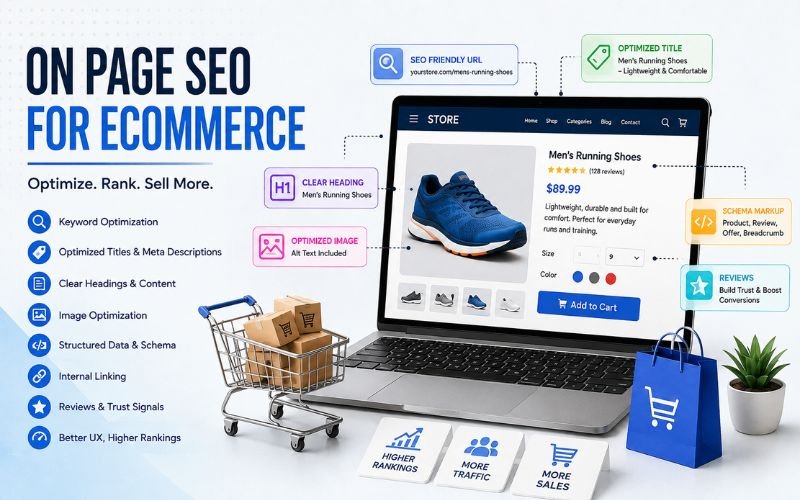
A Shopify SEO agency may optimize:
- Product title
- Meta title
- Meta description
- Product description
- H1
- Product specifications
- Product images
- Alt text
- Reviews
- FAQs
- Shipping information
- Return information
- Internal links
- Related products
- Product structured data
The content should be original and useful.
If a manufacturer provides the same 150-word description to 200 retailers, copying that description onto your Shopify store does not give your website much differentiation.
Instead, explain what the product does, who it is for, its important features, limitations, sizing, materials, use cases, maintenance requirements, and other information that genuinely helps customers make a decision.
4. Collection Page SEO
Collection pages can be powerful organic landing pages.
For example, a clothing store might have collections for:
- Women’s Winter Jackets
- Waterproof Jackets
- Lightweight Jackets
- Hiking Jackets
- Insulated Jackets
Each collection should have a clear search purpose.
We optimize collection pages around relevant commercial search terms while keeping the content natural.
A strong collection page should help customers understand:
- What products are included
- Who the collection is for
- How the products differ
- What features matter
- How to choose the right product
SEO text should support that experience rather than overwhelm it.
5. Shopify Technical SEO
Technical SEO becomes increasingly important as a Shopify store grows.
Shopify handles many technical elements automatically, but automatic does not mean perfect for every store.
An agency should investigate issues involving:
Indexation
Search engines do not need to index every URL your store can generate.
We review which pages are valuable for organic search and whether unnecessary URLs are creating indexation problems.
Canonicalization
Similar or duplicate pages can create uncertainty about which URL should be considered the primary version.
Canonical signals should be reviewed as part of the wider site architecture.
Redirects
When products or collections are renamed, moved, or discontinued, old URLs may already have search visibility or backlinks.
A thoughtful redirect strategy helps users and search engines reach the most relevant replacement page.
Site Architecture
Your important pages should be easy to discover.
A customer should not have to click through five unrelated pages to reach a valuable collection or product.
The same principle helps search engines understand how your pages relate to each other.
Page Speed
A visually impressive Shopify store can still be slow if it uses oversized images, excessive apps, unnecessary scripts, or a poorly optimized theme.
Performance should be evaluated using real-world data and relevant performance metrics rather than relying only on a basic speed score.
6. Structured Data and Product Schema
Structured data helps search engines understand specific information on a page.
For ecommerce websites, product structured data can communicate information such as:
- Product name
- Brand
- Price
- Availability
- Reviews
- Ratings
- Product identifiers
- Product variants
Google provides specific guidance for product structured data and merchant listing experiences. It also notes that using valid structured data does not guarantee that enhanced search results will appear. Google’s Product Structured Data Documentation
For Shopify stores with multiple variants, the implementation also needs to reflect how the actual products are presented.
Schema should support the visible information on the page. It should not be used to mark up information that customers cannot actually find on the website.
7. Google Merchant Center and Shopify SEO
Organic search and Google Shopping should not always be treated as completely separate marketing activities.
Google can use product information from websites and Merchant Center to understand ecommerce products and make them eligible for different search experiences.
Google recommends using product structured data together with a Merchant Center feed where appropriate because the combination can provide Google with more complete product information. Google’s Ecommerce Product Data Guidance
A Shopify SEO agency can therefore review:
- Product feed quality
- Product titles
- Product descriptions
- Product categories
- Product identifiers
- Images
- Pricing
- Availability
- Shipping information
- Return information
- Website product markup
This creates a more complete ecommerce search strategy.
8. Shopify Content Strategy
Your products answer the question, “What can I buy?”
Content can answer the questions that come before that.
For example, a skincare company could publish:
- How to choose a moisturizer for dry skin
- Vitamin C serum vs retinol
- How often should you use a face serum?
- What ingredients should sensitive skin avoid?
- How to build a simple skincare routine
A furniture store might create:
- How to choose the right sofa size
- Sectional vs traditional sofa
- Best sofa fabrics for families
- How to measure a room for furniture
- How to clean different upholstery materials
The important point is relevance.
Do not publish 100 generic articles simply because an SEO tool says there are 100 keywords.
Build content that helps your customers make decisions.
9. Internal Linking Strategy
Internal links connect the different parts of your Shopify website.
A useful structure might look like:
Blog → Collection → Product
For example:
A guide about choosing hiking boots can link to a hiking boots collection. That collection can link to individual products.
You can also create:
Product → Related Product → Buying Guide
This helps users continue exploring the site and gives search engines more context about relationships between pages.
A Shopify SEO agency should identify your most important commercial pages and build internal links toward them naturally.
10. Link Building and Brand Authority
You can optimize every part of your Shopify website and still struggle to outrank established competitors.
Authority matters, especially in competitive industries.
A quality Shopify SEO agency should focus on earning relevant links and mentions rather than selling you a specific number of backlinks every month.
Potential strategies include:
- Digital PR
- Industry publications
- Expert contributions
- Original research
- Resource pages
- Product reviews
- Relevant business directories
- Supplier relationships
- Industry partnerships
- Data-driven content
- Brand mentions
One relevant link from a respected website can be more valuable than dozens of unrelated links.
11. Shopify SEO for AI Search and LLM Citations
This is becoming an important part of ecommerce visibility.
Customers are increasingly using AI-powered search experiences to research products, compare brands, ask buying questions, and discover businesses.
That includes Google’s AI search experiences and conversational platforms such as ChatGPT, Gemini, and Perplexity.
But there is a common misunderstanding about AI SEO.
There is no reliable trick that guarantees an LLM will recommend or cite your Shopify store.
Instead, you need to build a website and brand that AI systems can understand and verify.
Google’s guidance on AI features in Search states that the same foundational SEO practices remain relevant for AI search experiences. Google also advises site owners to focus on unique, valuable content rather than producing large amounts of low-value content simply because generative AI makes production easier. Google Search Guidance on AI Features
How Can a Shopify Store Improve Its Chances of Getting LLM Citations?
A strong AI visibility strategy can include:
- Clear company information
- Consistent brand identity
- Detailed product information
- Strong topical coverage
- Original research
- Expert content
- Product comparisons
- Useful buying guides
- Author information
- Customer reviews
- Structured data
- Relevant third-party mentions
- High-quality backlinks
- Strong internal linking
- Accurate factual information
Third-party sources are particularly interesting.
If several credible websites discuss your company, products, expertise, or industry contributions, an AI system has more external context from which to understand the brand.
That does not guarantee a citation.
But it creates a stronger information ecosystem around your business.
LLM Citations Are Not the Same as Google Rankings
This distinction matters.
Ranking in Google and appearing as a cited source in an AI-generated answer are related but different outcomes.
A page might rank well for a keyword but never be cited by an AI system.
Likewise, a brand can be mentioned in an AI answer because information about the brand exists across several authoritative sources.
That is why modern Shopify SEO should include both search visibility and entity visibility.
12. Entity SEO for Shopify Brands
Google and AI systems need to understand what a business actually is.
Is it a clothing company?
A skincare manufacturer?
A supplement brand?
A furniture retailer?
A marketplace?
A recognized expert in a particular category?
Entity-focused SEO helps build that understanding.
For an ecommerce brand, this can involve making relationships between the following elements clear:
Brand → Products → Categories → People → Expertise → Publications → Reviews → Industry → Locations
For example, if your company sells premium hiking equipment, your website should not only contain product pages. It should demonstrate meaningful knowledge about hiking equipment, materials, product selection, outdoor use cases, and related topics.
This gives search systems more context about your brand.
13. E-E-A-T and Trust for Ecommerce Websites
People need to trust an ecommerce business before handing over their money.
Your website should clearly communicate:
- Who you are
- What you sell
- How customers can contact you
- Where your business operates
- Shipping policies
- Returns and refunds
- Payment information
- Product specifications
- Customer reviews
- Company information
- Author or expert information where relevant
For products that require specialized knowledge, demonstrate real experience.
Do not fill pages with generic statements that could apply to every competitor.
Show what your company actually knows.
14. Conversion Rate Optimization and Shopify SEO
Traffic is not the final objective.
Suppose SEO increases your monthly organic visitors from 10,000 to 25,000, but sales barely change.
That is not the result you want.
A Shopify SEO agency should therefore pay attention to conversion signals.
Depending on the store, this may involve reviewing:
- Product photography
- Product descriptions
- Reviews
- Trust badges
- Shipping information
- Returns policy
- Calls to action
- Mobile navigation
- Product filters
- Pricing presentation
- Page layout
- Checkout friction
SEO should bring qualified customers to the website. The website then needs to give those customers a good reason to buy.
How to Choose the Right Shopify SEO Agency
Not every SEO agency that says “Shopify SEO” provides the same service.
Before hiring one, ask practical questions.
Do They Understand Ecommerce?
SEO for a service business is not the same as SEO for a store with thousands of product URLs.
Ask whether they have experience with:
- Product SEO
- Collection SEO
- Product variants
- Ecommerce schema
- Merchant Center
- Faceted navigation
- Out-of-stock products
- Large product catalogs
Do They Explain Their Strategy Clearly?
Be cautious if an agency cannot explain what it plans to do.
You should understand:
- What will be optimized
- Why it matters
- Which pages are priorities
- What content will be created
- How authority will be developed
- How results will be measured
Do They Focus Only on Rankings?
Rankings are useful, but they are not the whole story.
Ask whether the agency measures:
- Organic traffic
- Qualified traffic
- Leads
- Transactions
- Revenue
- Conversion rate
- Search visibility
- Search Console performance
Do They Understand AI Search?
You do not need an agency promising guaranteed ChatGPT rankings.
In fact, that should make you cautious.
Look for an agency that understands the relationship between traditional SEO, entities, structured information, content quality, brand authority, third-party references, and AI-generated search experiences.
Do They Have a Clear Reporting Process?
You should know what your SEO agency is doing every month.
A useful report should show progress, problems, completed work, and next priorities rather than simply sending a ranking screenshot.
How Long Does Shopify SEO Take?
There is no universal timeline.
A technically unhealthy Shopify store may see improvements after important technical problems are resolved.
Competitive keywords usually require more time because you are competing against established websites with years of content, links, brand recognition, and customer signals.
A realistic campaign may look something like this:
Months 1 to 2: Audit, strategy, technical fixes, keyword mapping, and priority page optimization.
Months 3 to 4: Content development, internal linking, authority building, and continued technical improvements.
Months 5 to 6: Broader keyword visibility, stronger content coverage, improved commercial page performance, and more organic traffic.
6 to 12+ months: Continued authority growth, competitive keyword improvements, stronger organic revenue potential, and expansion into additional search opportunities.
These are working ranges, not guarantees.
Your industry, competition, website history, content quality, domain authority, catalog size, and implementation speed all influence results.
How Much Does a Shopify SEO Agency Cost?
Shopify SEO pricing depends heavily on the size and complexity of your store.
A small Shopify website may need a focused SEO campaign.
A large ecommerce store may require ongoing technical SEO, content production, product optimization, link acquisition, Merchant Center management, analytics, and international SEO.
Pricing can depend on:
- Number of products
- Number of collections
- Website size
- Competition
- Target market
- Technical complexity
- Content requirements
- Link building
- International SEO
- Existing domain authority
- Business objectives
A professional agency should ideally audit your store before recommending a package.
If an agency gives exactly the same strategy to every Shopify business, that is worth questioning.
Why Choose Niche SEO Agency for Shopify SEO?
At Niche SEO Agency, we believe ecommerce SEO should be connected to the actual business.
We do not want to generate traffic that has no commercial value.
Our Shopify SEO strategy can combine:
Technical SEO
We identify and resolve issues affecting crawling, indexing, architecture, performance, and search visibility.
Product SEO
We optimize important product pages around relevant search intent and customer needs.
Collection SEO
We build stronger commercial landing pages that target broader category-level searches.
Content
We develop useful content that answers customer questions and supports product discovery.
Authority Building
We work on relevant backlinks, mentions, digital PR, and brand authority.
Google Shopping
We consider Merchant Center and product data as part of a wider ecommerce search strategy.
AI Search
We optimize for the broader search ecosystem, including entity understanding, structured information, topical authority, and opportunities for third-party citations.
Conversion
We look beyond traffic and consider whether organic visitors are actually becoming customers.
Shopify SEO Agency vs Doing SEO Yourself
You can absolutely handle some Shopify SEO yourself.
If you have a small store, basic SEO knowledge, and enough time, you can start with:
- Writing unique product descriptions
- Optimizing titles
- Improving images
- Creating useful content
- Adding internal links
- Setting up Search Console
- Monitoring organic performance
The challenge comes when your store becomes larger or your competition becomes stronger.
Technical problems become harder to identify. Keyword opportunities become more complicated. Content needs become larger. Product catalogs require better organization. Competitors become more aggressive.
That is usually when professional Shopify SEO support starts making more sense.
Final Thoughts
Choosing a Shopify SEO agency is not about finding the company that promises the fastest ranking improvements.
It is about finding a partner that understands how ecommerce actually works.
The right agency should be able to look at your Shopify store and connect the dots between technical SEO, products, collections, content, internal linking, authority, Google Shopping, AI search, and conversions.
Search is changing, but the fundamentals still matter.
Useful information matters.
Clear site architecture matters.
Accurate product data matters.
Trust matters.
Relevant authority matters.
And most importantly, your website needs to help people make confident purchasing decisions.
We build Shopify SEO strategies around those principles.
Whether you are launching a new Shopify store, trying to recover lost organic traffic, expanding a large product catalog, or competing with established ecommerce brands, our team can help you identify the opportunities and build a practical roadmap for sustainable organic growth.
Ready to turn your Shopify store into a stronger organic sales channel?
Contact Niche SEO Agency to discuss your Shopify SEO goals and find out where your store has the greatest opportunity for growth.